
What Is an R-Value?
An R-Value is a measure of how strongly building insulation resists heat flow. Higher R-Values indicate greater resistance, while lower R-Values allow heat to pass more easily. The rating helps compare insulation materials and guide choices for walls, roofs, floors, and other parts of a home’s thermal envelope.
Quick Facts About R-Value
Category
Insulation performance measure
Used for
Comparing insulation in building assemblies
Common confusion
A higher rating doesn't fix air leaks
Also called
Thermal Resistance, Thermal Resistance Value
Often discussed with
Custom Home Building
Key Takeaways About R-Value
- R-Value describes resistance to heat flow.
- Insulation type and installation affect real-world performance.
- R-Value isn't the same as insulation thickness.
How R-Value Works
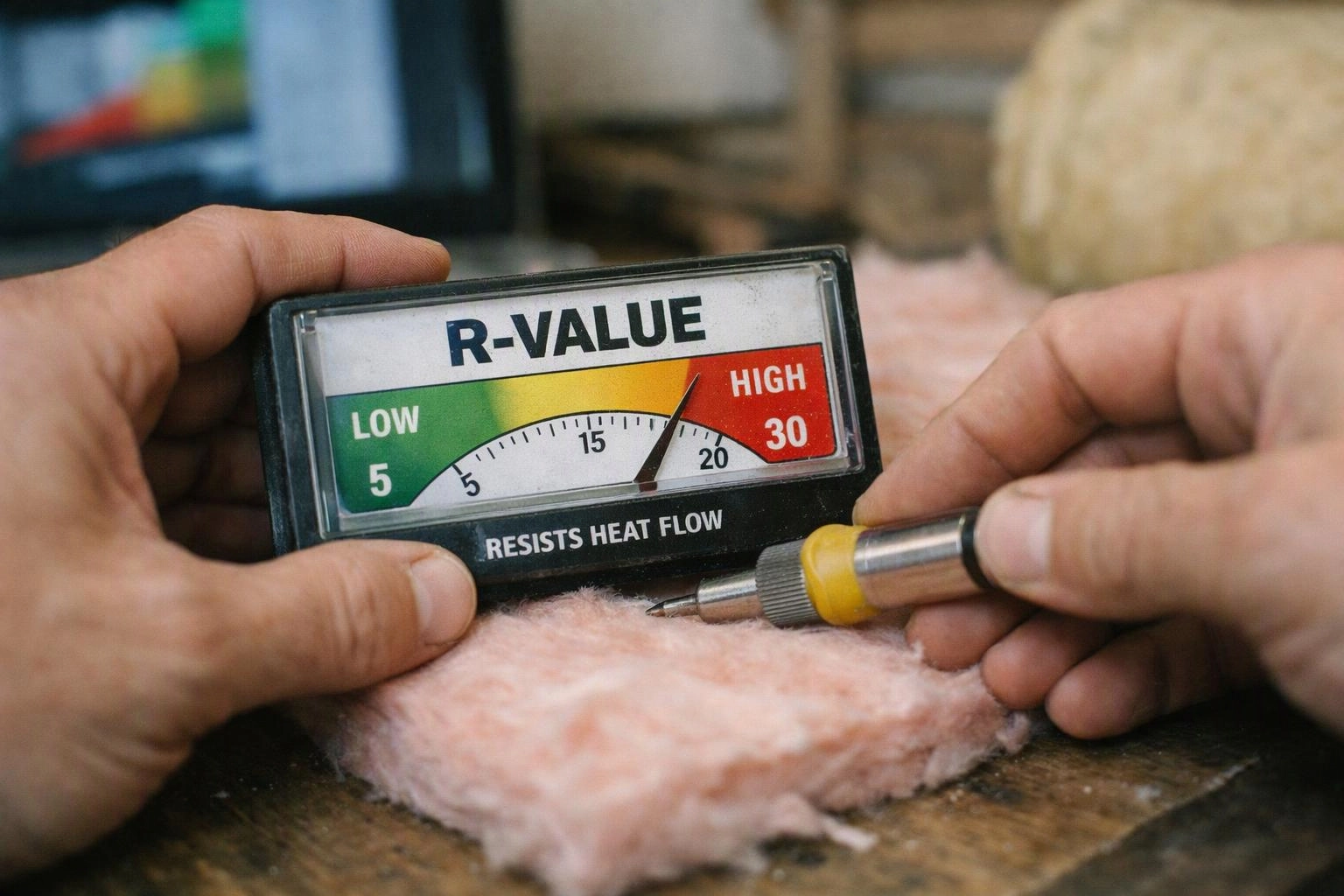
R-Value measures resistance to heat movement through insulation. Heat naturally moves toward colder areas, so insulation slows that movement through walls, ceilings, and floors. A higher rating means the material offers more resistance.
Related glossary terms: Air Sealing, Framing, Rafter.
Installers consider the insulation material, its thickness, and how well it fills the space. Gaps, compression, moisture, and air leaks can reduce the assembly's real performance. Air Sealing helps control moving air, while Vapor Barrier placement helps manage moisture in suitable assemblies.
For a custom home, the planned wall and roof assemblies guide insulation choices. The final result depends on the complete assembly, not one product label.

Expert Note
When we plan a custom home, we review the insulation layers as part of the full wall, roof, or floor assembly. We also check for gaps, compression, and air paths because the labeled R-Value does not describe installation problems. Our team coordinates these details with framing and air-sealing work.
R-Value in Practice: A Real-World Example
For a custom home with an insulated roof, the design team may select insulation with a suitable R-Value for the roof assembly. The crew must fit the material tightly around framing and seal nearby air paths so the assembly performs as planned.
Related Services
Related Terms
Air Sealing
Air Sealing is the process of closing unwanted gaps and cracks in a building enclosure. It…
Framing
Framing is the structural assembly of studs, joists, rafters, beams, and other members that forms a…
Rafter
A rafter is a sloped structural member that supports a roof deck, shingles, insulation, and related…
Vapor Barrier
A vapor barrier is a building material that slows water vapor from moving through walls, floors…
HomeRemodelSnoqualmie.info
Have Questions About R-Value?
Contact HomeRemodelSnoqualmie.info for practical guidance on R-Value and related general contractor work in Snoqualmie.